Tag Archive | Andalucia

The Science Museum of Granada

After our previous very unfortunate and “ill-fated” visit to Granada – ill-fated because after scrimping and saving in order to take my son to the Science Museum of Granada (Parque de las Ciencias) for his birthday – when we finally got to go, since museums here in Spain usually close on Mondays, we very deliberately made sure to go on a Tuesday…… and it was closed! The only week of the year in which the Science Museum opened on Monday in order to close on Tuesday, because it was a holiday, and that was the week we chose to go!

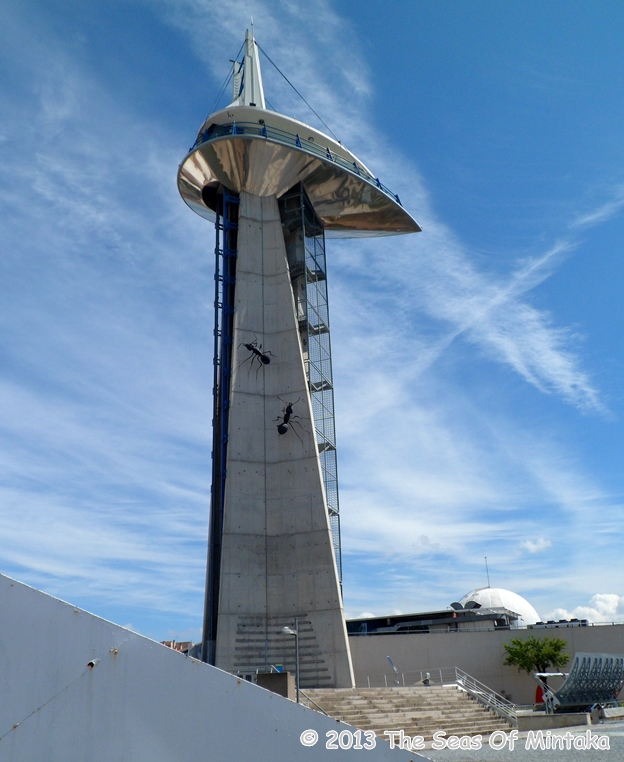
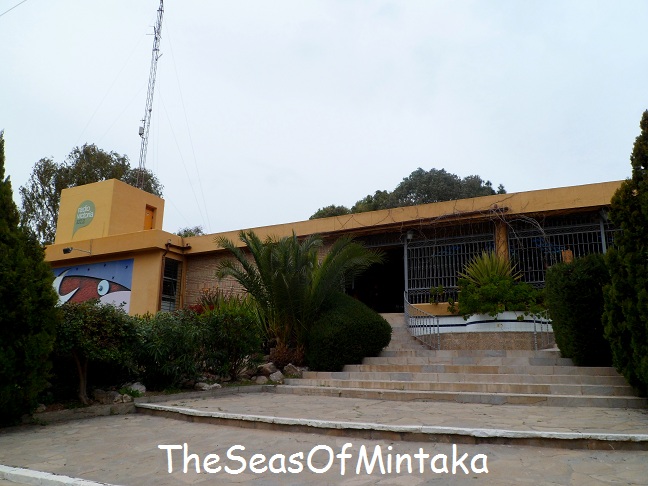
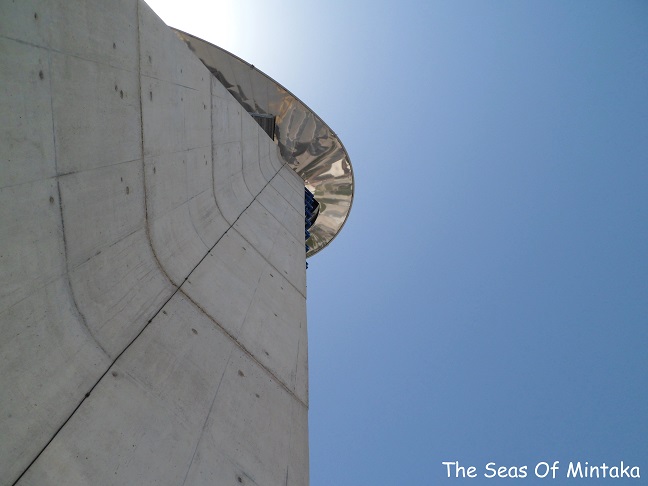
Observatory TowerSo at any rate, as a very belated (as in, one year and one month late) birthday present, we finally managed to get into the museum.

Science Museum GranadaWe’re very hard put to get to Granada, even though it’s not that far from Malaga, only about an hour by car. But if you don’t have a car, it’s a 60€ round trip for three people, and of course, when two of these three people are unemployed minors, guess who has to foot the bill?

We watched a falconry display (actually, more accurately a bird of prey show) featuring an owl, an eagle and a falcon. The falcon took off for a long flight and most spectators got bored waiting for it to return and left. People today have such short attention spans!

The Science Museum also boasts a large Butterfly Zoo with exotic species from around the world. It was supposed to be a “tropical” zoo, but I think it was hotter outside (it was a very hot day, about 36º Celsius) than inside the zoo.

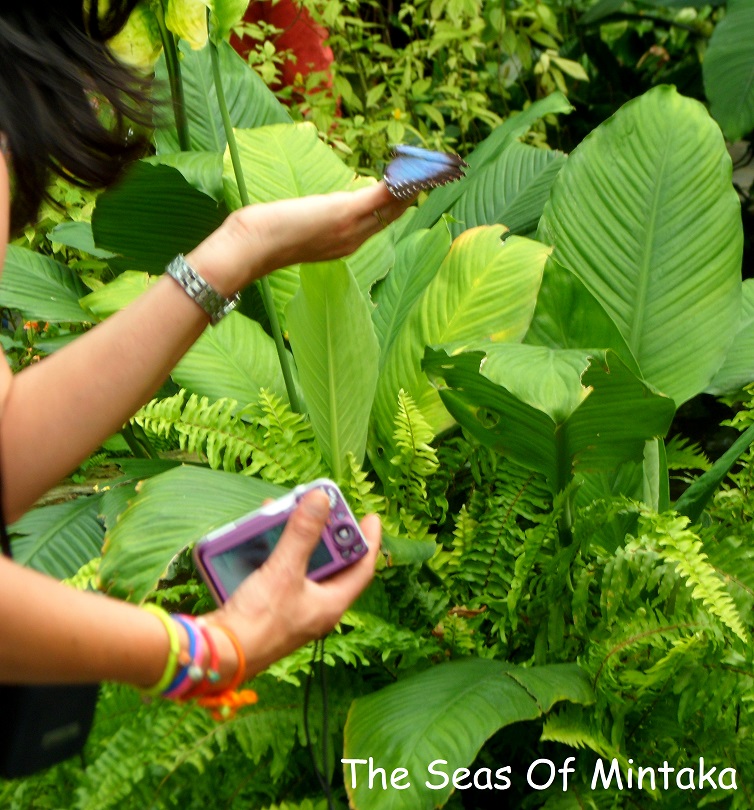
One girl enjoyed the immense good fortune of actually persuading a butterfly to alight in her hand.

Girl Holding ButterflyThis is a machine for creating tornados and hurricanes in the water.

Turbo TubeThe Science Museum has a tall tower with an observatory at the top, which you can reach by going up in a glass elevator. I took photos of the view of Granada from all around the tower, but most of them only came out so-so because Granada doesn’t have a particularly compelling skyline.

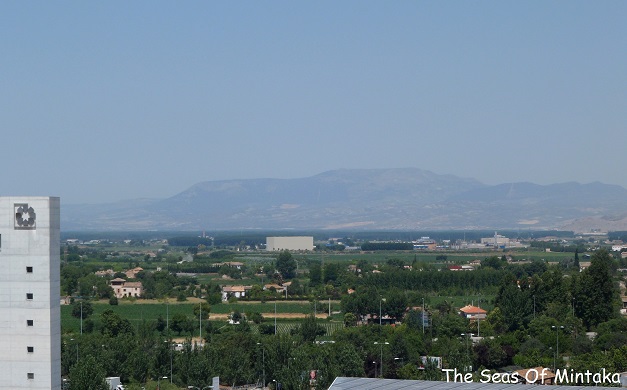
Granada Aerial ViewOne thing that was quite strange, however, was that there was still snow on top of Sierra Nevada, now in June, in spite of the most impressive heat that we were experiencing in the city (36º Celsius of pure, cloudless sunshine).

Sierra NevadaYou can choose to walk down by stairs instead of going down in the elevator, if you like. (You can also choose to walk up, but I doubt that that is a choice many would make.) If you choose to walk down, at every landing there is a sign telling you what height you are at, and some object on earth which is the same height.

My sons don’t work as workmen. But there was an activity that let you feel what it would be like to work in that profession.

In The WorkplaceThese odd, irradiant spacemen are not spacemen at all, but rather, my sons on an infrared camera. They had the time of it jumping around in front of the camera!

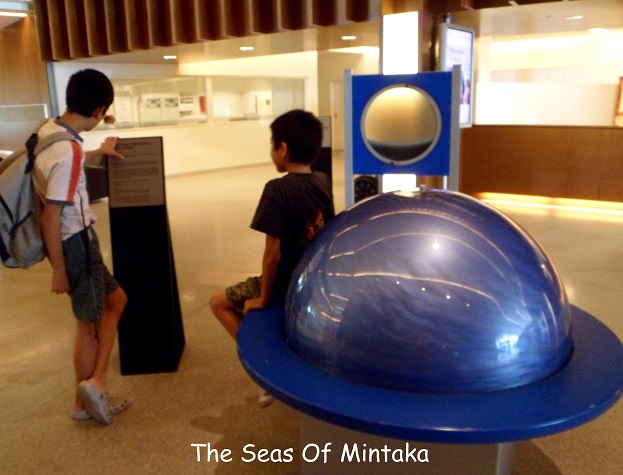
At the entrance to the museum are some balls that show how planets were originally formed, made with very finely-sifted, coloured sand floating in water, that you can spin around. You can see they also make stupendous carousels for children to ride on.

Riding on the PlanetsMy oldest son, who is a science junkie, couldn’t get enough of the museum, and read every single word on every single information panel. My youngest son, however, was thoroughly bored and tuned out about halfway through the visit. My recommendation if you plan to visit the museum with small children who aren’t particularly crazy about science? I would say to divide the visit over two days, if at all possible.

The museum is usually open from Tuesday to Saturday from 10 in the morning till 7 at night, it closes at 3 in the afternoon on Sundays, Mondays closed. But of course, as mentioned above, they are subject to unpredictable variations in their schedule, so if you are planning to go and you don’t live in Granada, check out their website to make sure it is open on the day you want to visit!

Their usual entrance fee is just 6,50 € for adults and 5,50 € for children ages 6 to 16 (wish “children” were considered children at all places, in most places round here “childhood” only lasts till the age of 13! Sigh!) and retired persons. There is also parking (paying, of course). Or you could try parking on the nearby streets for free (just make sure the tow truck doesn’t happen by or it will be far from free!).

If you enjoyed this post (I really hope you do!), maybe you will also like:

Stories From Granada

Spain Vs. Canada

A Celebration of Single Motherhood

Happy Giant Cockroach Hunting!

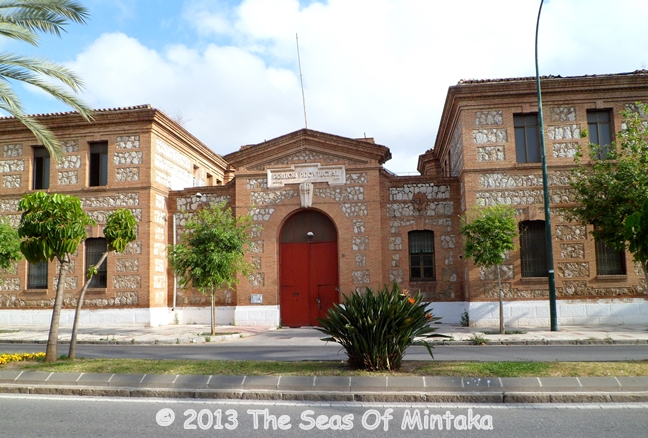
The Old Provincial Prison of Malaga

Plants in the Courtyard

Today butterflies flit where once people despaired and lost their lives. Now the only things that move through the overgrown courtyards and patios of Malaga’s Old Provincial Prison are stray cats and flowers ruffling daintily in the breeze and pushing their inexorable way into the sun-filled peace of this highly charged space.

Antigua Prision Provincial de Malaga

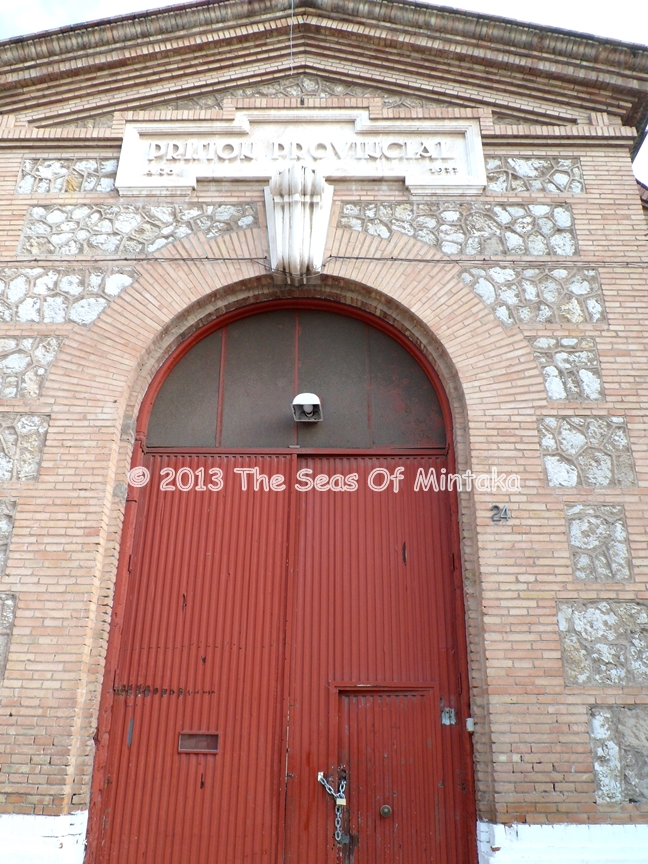
The doors of Malaga’s old Provincial Prison are closed and barred now.

Provincial Prison Door

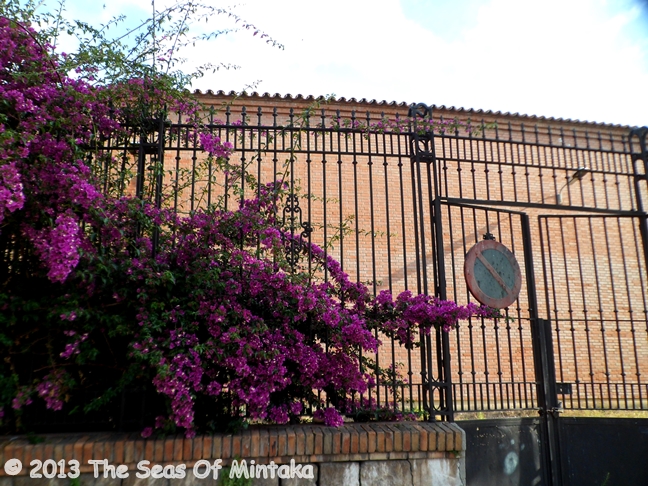
And nature continues to open a pathway through its abandoned walls.

Purple Flowers in Provincial Prison

Flowers and Locked GateThe former Provincial Prison of Malaga opened its doors in 1933, before the eruption of the Spanish Civil War, and its original purpose was similar to that of any prison: to house the usual delinquents and criminals, petty thieves, murderers, con artists, etc.

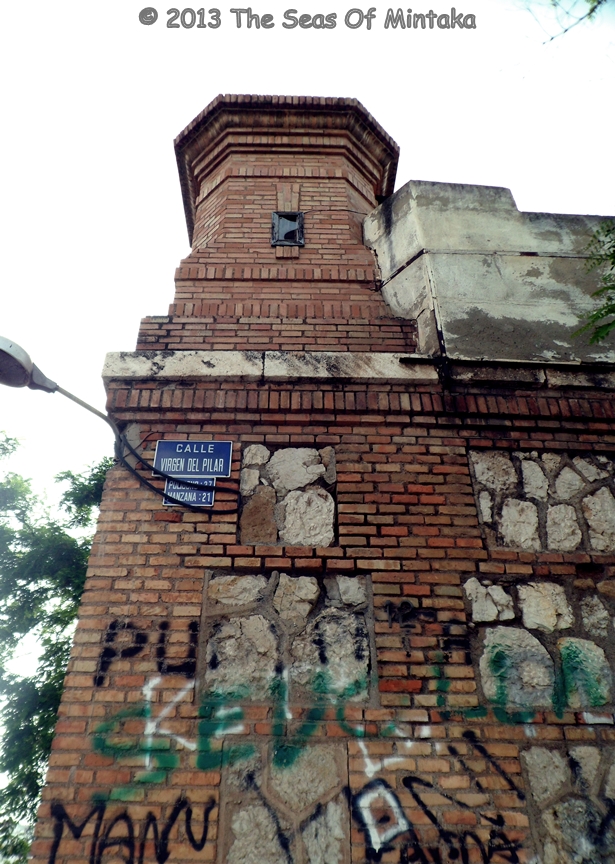
Courtyard and Guard TowerAfter the Spanish Civil War began, however, it took on a much more sinister taint. At the start of the war, Malaga was in the hands of the Republicans, the current leaders of the country at that time. Many Nationalists were held in the Provincial Prison as political prisoners, until Franco’s forces seized a hold of the city in 1937.

Guard Tower Against the SkyFranco’s bloody forces grabbed thousands of their enemies and confined them within these four square walls surrounded by guard towers and high fences, where they remained until the day of their executions.

Guard Tower and GrafittiPolitical prisoners were brought out to see the light of day one final time before being executed in public in front of thousands of on-lookers.

Plants in the WindowAfter the Civil War ended, political prisoners still filled up the ranks of those held within this small space for several years, until eventually the prison regained its original use, as a place to deprive the usual petty delinquents of their freedom.

And life went on within its walls.

Plants in the CourtyardThe prison was witness to a violent riot in 1985, where presumably some guards and police officers were killed. No one knows what became of the prisoners involved in the riot, but I doubt that they enjoyed a particularly optimistic fate.

Abandoned CourtyardThe Old Provincial Prison of Malaga began to lose its importance in 1991, when the New Provincial Prison was inaugurated in Alhaurín de la Torre, in the suburbs of the city. And finally, in 2009, this former architectural splendour closed its doors for good.

Courtyard With JacarandaIf you enjoyed this post (I really hope you do!), maybe you will also like:

Malaga in Black and White

Photographs From a Typical Day in a Life

The Orange Trees

Happy Giant Cockroach Hunting!

Holy Week in Malaga

I wasn’t going to put up a post on Holy Week, but we went to see processions and they were so beautiful, I just had to take some photos even though I hadn’t brought the camera along. But I’ve got a mobile phone, even though it doesn’t take such nice photos as the camera.

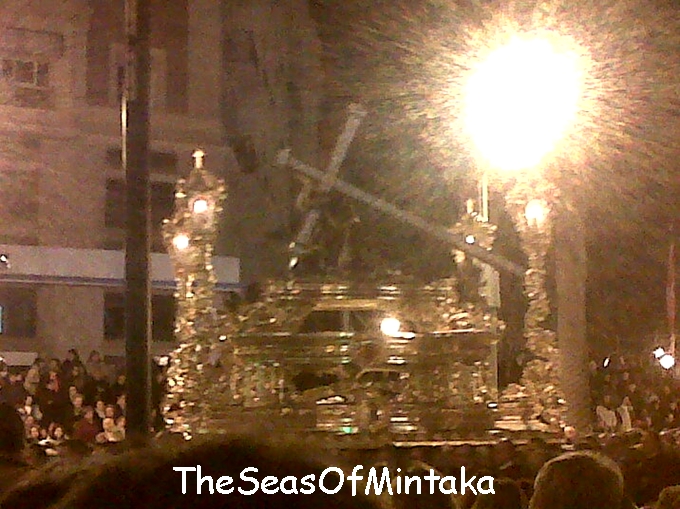
Cross

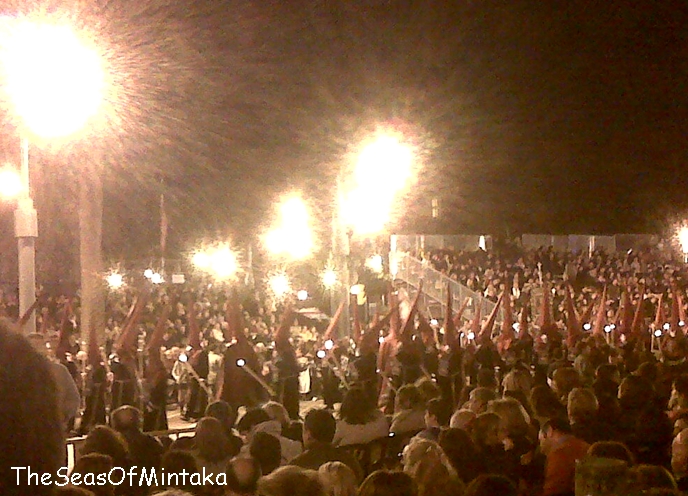
On Holy Thursday, the city is filled with processions running up and down all over the place. You can do like what we started to do, which was “procession hopping”, jumping about from one procession to another to see all the different religious statues, or tronos.

However we soon got tired of that activity, and just decided to situate ourselves next to the Alameda, the main thoroughfare in Malaga, because all the processions pass down that way at some point.

Penitents

These people carrying a glittering cross and wearing “cone hats” are penitents.

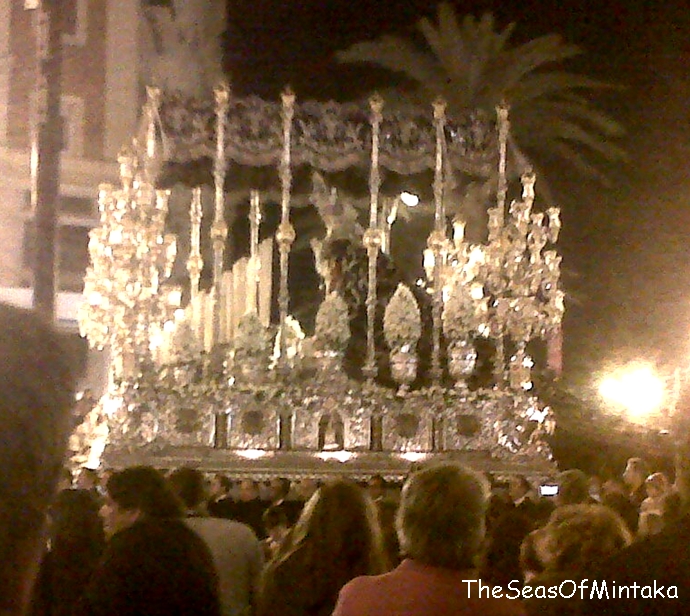
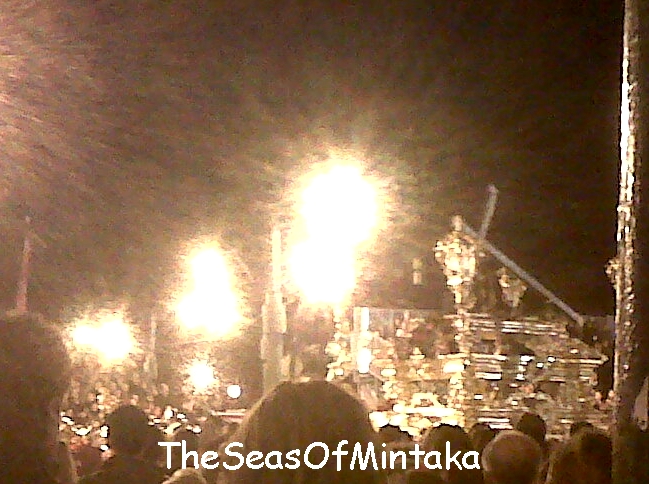
Trono de virgen

There’s a lot of religious fervour and excitement during Holy Week processions. Even people who haven’t entered into a church for the past fifty years feel awe-struck.

Spectators also applaud the brave and strong men who bear the tronos as they pass by. Each trono-bearer is carrying about 20 kg. on his shoulder. This is very exhausting work and they deserve all that applause, encouragement and confetti!

Niños aburridosHowever, the ones who would probably rather be sitting at home playing with their Nintendo or Gamebox are…… the kiddies. Here are some who are clearly bored out of their minds. But fortunately, today we have portable electronic apparatuses to play with.

Rows of Penitents

My son was quite fascinated by the penitents. He told me that he wanted me to fashion him a cone-shaped hat covered with velvet to wear around the house, and a huge gilded staff like the ones that the penitents carry.

My son’s cousin, a hale and hearty teenager, decided to participate in a procession this year bearing a trono. This wasn’t due to any religious zeal. He just wanted to know what it felt like. He ended up all ground up and declared that he was never going to do this again.

A little boy by our side apparently also had his father carrying a trono. As the statue paraded past us, the little kid just wouldn’t stop screaming at his dad to look at him.

Given the number of processions taking place each year, and the number of men required to make them happen, most of the inhabitants of Malaga probably know someone personally who is bearing a trono.

Another cross

Religion is a pretty important theme during Holy Week, of course – but so is partying! Everywhere we went, it seemed more like a carnival or a fair rather than a supposedly sombre religious event commemorating a rather tragic occurrence. There were people at stands selling everything from hot dogs and hamburgers to donuts and home-grown lemons.

Papas asadas

I think the line-ups to get baked potatoes stuffed with delicious hot filling were just as long as the ones to see a trono pass by.

Apparently, on Holy Thursday all of the processions consist of two tronos coming out of every church that participates. The first trono is always a statue of a cross, Jesus Christ or Jesus Christ on a cross. He is always followed by a statue of his mother, the Virgin Mary. Because if they were carting your son off to hang him, wouldn’t you go running after him too?

Cristo en la cruz

Well, I took a few more photos but I got so tired editing them, and besides which, they were all pretty much more of the same, and not such good quality anyways (after all, I do not have an iPhone!). In the end, what caught my fancy was this large tree with its roots hanging off of the high branches.

Tree Roots Hanging From Tree

I have no idea what this tree is called though. You can see the full moon shining beside it.

If you enjoyed this post (I really hope you do!), maybe you will also like:

Preparing For Holy Week

On Christmas Day in the Morning

Flowers for the Dead on the Day of the Dead

Our Visit to Hare Krishna

Preparing for Holy Week

I’d been getting this post ready for the past week or so, and then I realized that I’d better get it up soon or as they say in Spanish, “se me iba a pasar el arroz”. Which just simply means something like, the right time is about to pass you by.

Sentencia

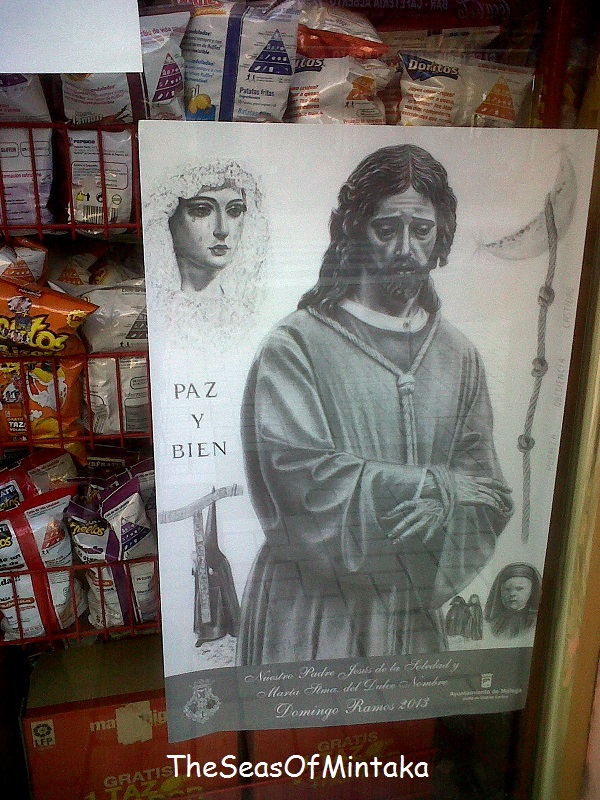
Sorry for the rather iffy quality of the photos, I took them all with the mobile phone, just little reminders posted everywhere as I walked about town, about the imminence of Holy Week and its numerous processions (procesiones de Semana Santa).

Semana Santa Malaga

People get really excited about Holy Week processions around here. Even very young people (like teenagers), whom you would expect would be more into fashion or clubbing than religion, show tremendous zeal and anticipation. And several young men that I know with big, strong shoulders can talk about nothing else for weeks except the “trono” that they are planning to bear around the city.

Cristo Triston

As you can see, everyone gets in on the act, and even the owners of convenience stores have Holy Week posters up.

Because, of course, all of those heavy “tronos”, or religious statues, that you will see marching around during Holy Week, are borne solely by the shoulders and feet of the “trono-bearers”. Each procession lasts for several kilometres, so you can imagine the exhaustion that these people face. But they are very proud of what they do and even compete with each other for the privilege of bearing a trono around town.

Encierralo

This is a poster with a play on words. It’s urging people to shut their cars up at home during Holy Week and come to see the processions by bus, in order not to clog up the frenetic traffic downtown. However, it’s also playing on the term “encierro”. Encierro means to shut something up, like your car in the garage, but an encierro is also when the procession is finished and the trono is brought to rest in its “home” in the church that it belongs to.

There was one other scene that I wanted to capture on film (well, digital film, nowadays), a religious scene that was set up in a shop window, but whenever I passed by the lighting was never right. Either it was too bright and everything was reflecting in the window, covering up the scene underneath the pane, or it was night-time and too dark. If I ever manage to pass by at just the right moment, I’ll flash a pic of it and post it up here too.

If you enjoyed this post (I really hope you do!), maybe you will also like:

29M: A General Strike or a Religious Procession?

Kings’ Day Parades

Midnight and All Is Well

Happy Giant Cockroach Hunting!

A Treasure Huntin’ We Will Go

The other day we went Treasure Hunting. That is easy when you live near a Treasure Cave!

Treasure Cave

Our Treasure Cave, La Cueva del Tesoro, is in Rincón de la Victoria right next to Malaga city. We go there every year, actually, but always when the weather is hot. (I won’t say in the summer, because it could be in October, and of course, technically, October isn’t summer – but the weather is still hot.)

This year my son, of the Wild Ideas of Hermenegildo fame, wanted to go there in the winter to see if it would be warm in the cave. You see, I had told him that Cave Homes, like the ones that Granada is famous for, are naturally conditioned and they are cool and fresh in the summer and warm and comforting in the winter, so you don’t need heaters or air conditioners if you live in a cave.

So we hopped on a bus for our annual pilgrimage to the Treasure Cave in Rincón de la Victoria. Whether you go there by bus or car, it’s easy to arrive – once you know the way. The problem is that the route isn’t mapped out or indicated with signposts anywhere (that I’ve seen).

Anyways, to get there, you take the big winding main road that passes through La Cala del Moral and Rincón de la Victoria, the coast road (not the autoroute). After La Cala del Moral this road will start winding its way up a large mountain, you will know it is the right place because it is very spirally and coils around a lot.

When you reach the top of this winding mountain road, at its highest point, that is the place to hop off the bus, if you are taking the bus in from Malaga. (Most buses that head eastwards out of Malaga will stop here for you.)

If you are taking the car, take advantage of the fact that you have a car and don’t hop out of it! Instead, veer to the left onto a road. I don’t know the name of the street, and there are no signs to indicate that it’s the right street. It’s just the street at the top of the winding mountain road where there is a traffic light (there aren’t any other traffic lights nearby). Very useful information, right?

When you get onto this street, just keep climbing and climbing and climbing…… and climbing. It’s great exercise for your legs, or for your car motor, if you come by car. You will come to a roundabout. Go around the roundabout and keep climbing.

Even when you arrive at the cave it is very easy to miss it. There is no sign or anything there to point out to you that you have arrived at a cave.

Treasure Cave Entrance

This is what the cave entrance looks like. As you can see, there is no way that you can tell that there is actually a cave somewhere in there!

The lighting was also pretty lousy, because it was, as usual, raining. A Cuban acquaintance once told me, “I dunno why they call this the Sun Coast. They oughtta call it the Always Cloudy Coast, or the Rainy Coast. Now Cuba, that’s a whole different story. In Cuba it is sunny all the time.”

However, one of the reasons I chose Malaga is because it does rain. If I had wanted perpetual sunshine, I would’ve headed off to Almería, which is a desert.

Shapes and Shadows

Anyways, the entrance fee is very cheap. And if your kids are members of the Club “La Banda” and have their membership card, entrance is free for them.

The only way to see the cave is with a guided tour. Guided tours are very frequent and run every half hour or so. Take care though, as they do close for lunch and the last tour in the wintertime is at 5 o’clock. (In the summer, I believe it is open an hour later. Which is good because at 5 o’clock in the summer you will die from sunstroke.)

Okay, well I’m not going to wax informational and spit out information that you can read on any website or tourism pamphlet about these caves. I’ll just mention a few bare facts.

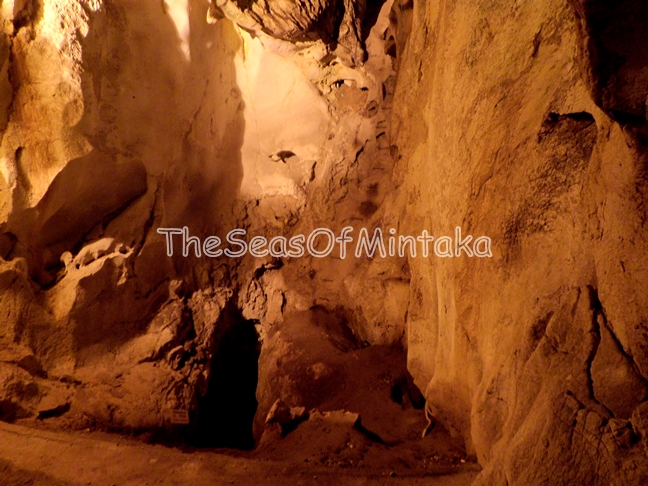
This cave is special because it was an underwater cave, and it was formed entirely from the erosion of seawater on the rocks. After the seawater withdrew and the level of the sea went down, this cave emerged. There are only three underwater caves in the world (that is, caves that used to be underwater and are now above ground) and this is the only one in Europe.

It got its name because of the legend that this Roman guy hid away in it for eight months escaping from his enemies, and left an enormous treasure behind inside this cave. Many people have gone a-searching for this treasure, but they’ve all left their fortunes, energies and the health of their backs in the process (I mean, after all, excavating isn’t supposed to be exactly the most beneficial exercise for your back, right? If you want to strengthen your back, I would recommend you take yoga classes rather than spending all your time digging in a cave), without any luck.

Eagle

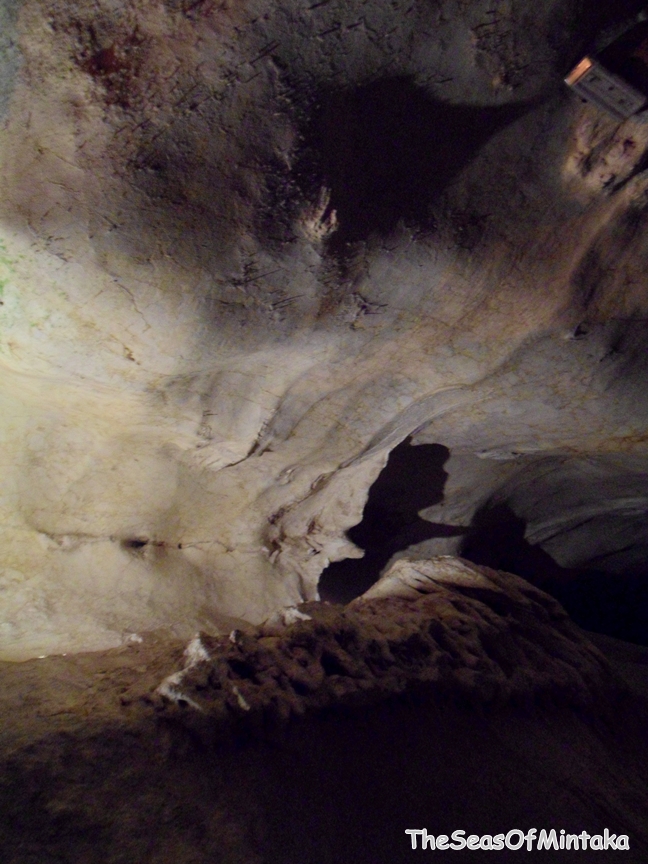
The first cavern you will enter is called the Eagle Cave (la Sala del Águila). This is because of this rock formation which looks like an eagle’s back and head. (Sometimes the photos didn’t come out too well because we couldn’t use flash.)

Cave of Noctiluca

The next cavern is the Cave of Noctiluca. Noctiluca is the goddess of the night, the full moon and fertility. In prehistoric times, people made offerings of the sacrifices of small animals to her. They slaughtered the animals and dribbled the animals’ blood into a basin below her “statue” (in reality, a natural rock formation).

Cave of Noctiluca outlined

In case you can’t distinguish her silhouette too well, here it is in outline. (At least that’s the way I see it. You know, these things are like constellations, you have to throw in a lot of imagination to see what people say they see.) The large round hole above her head is supposed to represent the full moon.

Cave Crystals

These are some crystals glistening in the cave walls.

Cave of Lagoons

This is the Cave of the Three Lagoons, because it has three natural lagoons in it. (The photo isn’t very clear because these guided tours run around as if they were some sort of marathon instead of a touristic stroll. I usually like to take several shots of everything and then choose the best shot, but in this case, they wouldn’t let me, because they were all galloping about as if the cave were about to crash down upon us or something.)

Lagoon Cave of Lagoons

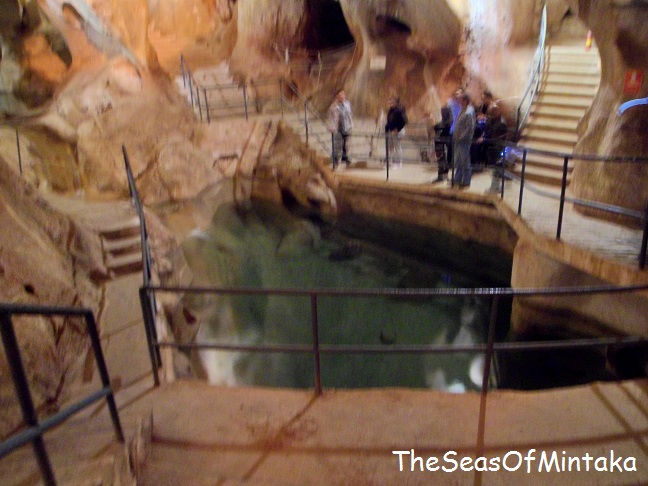
This is a cave which is still in the process of erosion, because rainwater continues to seep into it and form little streams and, of course, these lagoons.

More Shapes and Shadows

I had the pleasure of translating the tourism pamphlets for the City of Rincon de la Victoria, and if you go to the Tourism Office in that town, you can read my translations in English. They also offer a free audio guide in English that you can download to your iPhone or SmartPhone and if you do that, you can listen to me, since I did the English recordings.

However, apparently Management at the Treasure Cave didn’t take advantage of my services and had their information panels translated by someone who was obviously not a native English speaker. The result is that you can read such strange headlines such as “The Geological Training of the Caves” instead of “The Geological Formation of the Caves” (La Formación de las Cuevas).

(Oh that is so not nice of me to laugh at someone else’s bad work, isn’t it?)

Hole in the Ground

This is one of the many openings that the cave has into the ground above.

The Cave of the Three Lagoons is the last cavern to be visited in the guided tour, which is fairly short.

And as to the answer to my son’s question, as to whether caves are warm in the winter? Well, we still had to keep our jackets on during the frenzied relay race er, I meant, guided tour. The only area where it was warm enough to walk around in T-shirts was in the deepest cavern (not shown in this post), the Volcano Cave.

Well, just had to end this post with an outdoors pic, instead of yet another dark, lugubrious, underground photo. This is the coastline at Rincon de la Victoria.

Rincon de la Victoria

If you enjoyed this post (I really hope you do!), maybe you will also like:

Marbella, Land of the Jet Set?

Selwo

What We Do On Week-ends

Subways Around the World

Pa Amb Tomàquet

Oops, that’s not quite right, wrong Community, I think. I meant: pan con aceite!

Andalucia Flag

Next week is the Day of Andalucía, which commemorates the date when Andalucía won the status of Autonomous Community within the country of Spain.

People get patriotic and hang out flags, and in the schools they set up little plays (which unfortunately we parents won’t be privy to observing). My son’s got a role in the play his class has mounted up at his high school: he’s going to open the curtains at the start of the show and close them when it ends. (He hates acting!)

His little brother cracked up when “Hermenegildo” proudly announced his important assignment. But I explained that it’s very important that someone open the curtains too, because if no one does that, then the show can’t go on!

What the kids love most about the Day of Andalucía, however, is pan con aceite!

Pan con aceite

Yes, the schools regale them with a typical Andalusian breakfast: rustic bread dunked in pools and pools of fresh virgin olive oil.

Too bad this wonderful meal is also accompanied by homework assignments for spring break (okay, winter break, since I guess technically it’s still winter……).

Thought I’d close this post with a flash of almond blossoms. Living in da inna big city isn’t the hottest thing, but occasionally, we get a real treat from Mother Nature too.

Almond Tree

If you enjoyed this post (I really hope you do!), maybe you will also like:

A General Strike? Or a Religious Procession?

Malaga’s Annual Fair and Roller Coasters

Hot Muggy September Nights

Kings’ Day Parades

The Orange Trees

I love to see orange trees. I really love the sight of these perennial greens loaded down with fruit. Growing up in Canada, we never saw oranges, of course. In fact, it was inconceivable and totally impossible, to me, that any plant could keep its leaves twelve months of the year (except conifers, of course). Oranges were this rare, exotic thing that arrived in crates from California or Florida, half-wilted already.

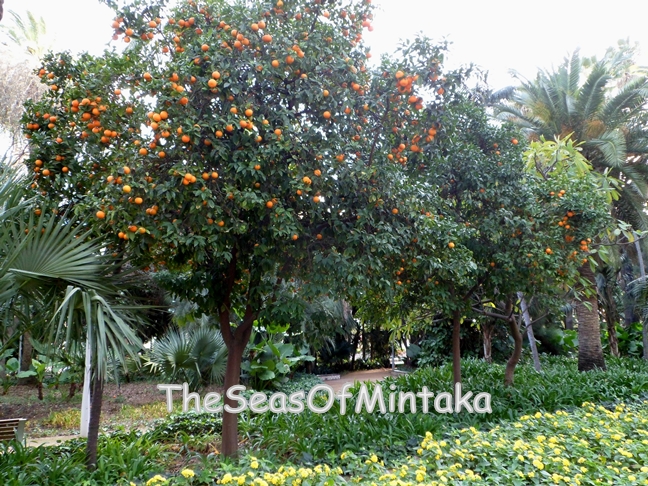
Oranges in a Garden

So I love to see orange trees, because they remind me that we don’t live in the Arctic anymore! I love to see them because they tell me that in some parts of the world, there is life the whole year round.

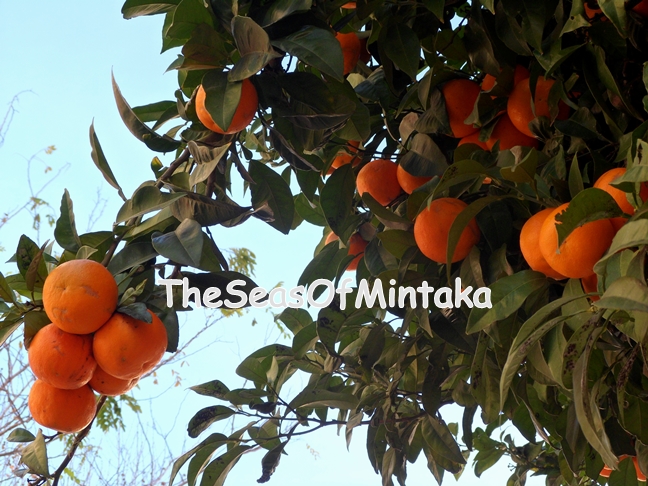
Oranges Hanging From a Tree

I stop often to take photos of them, and every once in a while, I’ll upload a few of these photos here. Not too many at a time (although I literally have dozens!), because if I beat you over the head with endless scenes of oranges, well, that’s no fun.

Oranges At Night

Oranges grow all over the place here. You can’t eat them, though. Otherwise, how would supermarkets and fruitmongers survive? The oranges that grow out on the street are bitter oranges. You could, I suppose, take a few home for free and make bitter orange jam with them. But why would you want to do that, anyways, when you can get a jar of bitter orange jam for about a euro at the supermarket, and save yourself all the fuss? Besides which, the ones on the streets must be chock full of contamination and pollution from sucking up car fumes all the time.

Table Oranges

But they sure are nice to look at!

The Orange Tree

Rainy Courtyard

If you enjoyed this post (I really hope you do!), maybe you will also like:

…And It’s a Rainy Night in Malaga

Foray Into Black and White

Photographs From a Typical Day in a Life

The Blueberry Fiend

Spain Vs. Canada

I’ve been sitting around noticing how expats often blog about the differences between life in their new country and life in their country of origin.

Spain and Canada

(I’ve also been noticing how widespread it seems that bloggers who have never left their own country just naturally assume that everything is going to be exactly the same in all the rest of the world as it is in their own country. I would LOVE to be able to inform them that not everyone around the world has access to The Vitamin Shoppe, and that we can’t all order online from US internet sellers, but anyways…… And those people who run blogs like that would never read this one……)

But anyways, so I thought I’d do something similar. Now, taking into account, however, that I’ve been living in Spain for so many years, it’s almost more like my own country than my real own country. But even so, there are several things that do jump out at me, so let’s go, on with the list:

* One of the very first things that struck me is how different ordinary, everyday objects can be. Door handles, toilet bowls, light switches and, of course, electrical outlets. In Canada everyone has round door handles. That’s just the way door handles are made there, I guess that’s how Canadians like it. Here, however, door handles are long. I actually like them better here, the round ones are always slipping out of your hands whereas here, you’ve got something you can really get a good grip on! (They also make great hooks for hanging stuff on.)

* In Canada, there’s only one way to flush a toilet bowl: using a little lever on the front of the tank that sticks out a little to one side. Here, on the contrary, there are so many different contraptions each with their own way of flushing. The first toilet bowl I ever saw here had nothing but a little ball on top of the tank. What in the world are you supposed to do with a little ball?? I tried spinning it around, pushing on it, edging it in one direction and another, all to no avail. At some point (probably when people were starting to wonder whether I had actually fainted or something in the bathroom) it occurred to me to pull on it! Wonder of wonders, it worked!

* The bidet. Does anyone reading this have a bidet? (I, of course, do not, seeing as I live in a minuscule, cramped one-bedroom-with-a-walk-in-closet-as-the-second-bedroom.) The first time I saw one I didn’t know what it was, or what you were supposed to do with it. Was it some sort of strange, low-level wash basin for little kids to wash their hands and faces in? Was it a weird sort of toilet bowl, maybe? In the end I myself ended up using it to wash things (like clothes) by hand, very useful for that sort of thing.

* Spain is very, very urban, compared to Canada. Even in a major city in Canada all sorts of wildlife prowl the streets: hares, chipmunks, racoons, skunks and even the occasional red fox, not to mention the ubiquitous squirrels of every colour. I expected to find bulls roaming free in the streets of Madrid at the very least, and yet it turned out to be one of the most urban, built-up, concrete-and-cement jungles I’ve ever encountered. You can travel for miles (well, several blocks anyways) without seeing one little piece of greenery. And animals? The only thing you will find is a pigeon.

* I suppose every expat in Spain must have noticed this but I will mention it anyways: the total (or almost total) lack of foreign goods and imported products (with the exception, of course, of electronics like computers, Nintendos, Wii’s……). The list of foods you can’t get here in Spain would be so long it would probably cover reams and reams of paper. You can’t get a lot of make-up either, unless you are really into mass-produced junk churned out by companies that test on animals like L’Oreal, or elitist little venues that charge a fortune for a tiny vial of something, like L’Occitane or La Mer. (Now, having said this, I still won’t deny that even so I would still LOVE to be able to get my hands on something from L’Occitane one day, just to try it out!) Now, I do realize that slowly all of this is changing. From what I’ve been reading, famous companies like BeneFIT and Nars finally seem to have made the discovery that Spain exists and that it actually has women, who use make-up. Hopefully more low-cost-but-good-quality US brands like ELF will one day follow suit, so that us “poor” women who don’t want to patronize animal testers can still afford to look good.

* Schools. Well, I don’t find schools a whole lot different here from in Canada. Sending kids to school is a tradition that dates back millennia, so I don’t suppose it is all that different now from one hundred years ago or from one continent to another. The curricula is also not that radical. Kids learn the basics everywhere, reading, writing and arithmetic. Throw in a bit of algebra and science. The one thing that has changed enormously, is the role of computers in the classroom – but that has to do with the times, not with the country.

* I find schools A LOT more secure here than in Canada. In Canada, anyone, like a maniac with a gun, can just wander into a school and when the kids leave, they just leave. Any creep can pick them up off the streets before their parents arrive. Here a teacher or monitor will personally hand the child over to the parent when s/he arrives, and not to anyone else. It can occasionally lead to paranoid moments, when for example a new teacher or monitor doesn’t know who you are, and refuses to hand your child to you because she doesn’t recognize you! And speaking of parents, in Canada most kids travelled to school by bus, in those famous yellow school buses, at least in my experience. Here, however, school buses are quite rare and parents themselves must pay for them. Most kids are personally brought in to school by their parents, no matter how far away they live.

On the other hand, school buses here are quite the luxurious item. We had to travel squeezed tightly into these cramped, dirty (well, the ones I travelled on were always dirty) yellow school buses while European kids breeze along in their airy, spacious, top-of-the-line luxury coaches. I always want to ask them if they realize how lucky they are to be able to go to school in one of those, which always look clean, and there is room for them to put down their backpacks and stick out their feet.

* Most things, in general, are just generally a lot more tightly controlled here in Spain than they are in Canada. That is, I think, both good and bad. The good thing is that not just anyone can have access to things and people here the way they do in Canada. For example, if you are in a hospital and someone is trying to kill you, it would be very easy for them to pay you a visit in Canada. But here, who can enter into a hospital room to visit a patient is very restricted. When my mother-in-law was in the hospital she was only allowed to receive visitors for two hours a day, only one visitor at a time and no children were allowed to see her. I thought that was extraordinarily sad, the people she wanted most of all to see were her grandchildren. In Canada, on the other hand, a whole bunch of us including babies could pile into a patient’s room, much to the patient’s great joy and relief.

Because Canadians don’t have ID cards, that sometimes makes things harder in Canada and sometimes easier. It’s harder, when (in Canada) a person is very paranoid and won’t let you have something unless you can produce about thirty documents that prove that you are who you say you are. Since there really is no norm in Canada that states that you must identify yourself a certain way, in other places you don’t have to do anything to prove that you are who you say you are. It all seems to depend mostly on the establishment’s own personalized, rather haphazard policies.

* Stores. Need I say it, it is a lot harder to buy anything in Spain, and generally a lot more expensive too. In Canada, we had all sorts of cheap-o shops where you could get things for a dollar or two (and I’m not referring to dollar stores). Drugstores sold make-up (and not exactly from China either) for a dollar or two. We had Zeller’s (which may not exist anymore) and Woolco (which I think has since been bought up by Walmart) where everything was cheap. Pyjamas for the kids were cheap. Shoes for the kids were cheap. Shampoo was cheap. Diapers were, perhaps, the only thing that wasn’t cheap there! You’ll never find something like that here in Spain!

* Convenience. Living in Spain is like about a hundred times more convenient than living in Canada! In a Canadian city, you might have a grand total of perhaps THREE or at the most FOUR large supermarkets in the entire area, usually located in distant suburbs and generally requiring the use of two urban buses in order to arrive at the location. In Canada, most cities are divided into residential neighbourhoods and commercial districts, which makes the term “shopping in your own neighbourhood” a bit irrelevant. I LOVE being able to just hop downstairs when I want some bread or milk, rather than have to hop onto two buses for some bread and milk. (Well, of course, since I went to the trouble of hopping onto two buses and riding for perhaps two hours, I would of course buy more than just bread and milk, but I hope you get the picture.)

* Employment (hehe, this subject had to come up, of course!). Quite frankly, getting a job is a lot easier in Canada than in Spain. Not because it’s richer or has a great, booming economy (which it doesn’t, like every country in the world, it’s in crisis). The reason is because employers here in Spain are just so **** demanding! You can’t even work in a f***g McDonald’s here without possessing at least three different types of professional certifications and presenting about thirty references.

Basically, in order to work at the counter at McDonald’s here, you would need something similar to an MBA from Harvard, a few internships in a variety of different large corporations and a couple of courses of “Manipulador de alimentos” which you would, of course, have passed with flying colours (and be in possession of the official, government-issued certificates to prove it, too). Then later Americans ask me why don’t I just get a job at McDonald’s, since apparently in the US McDonald’s will just hand the position over to the first person who waltzes in off the street and asks for it. They say, after all, I don’t need any qualifications to work at McDonald’s, right, and anyone can do it? Snort snort! That must be in the States, because here……!

What kids habitually do in Canada such as delivering newspapers, selling lemonade or babysitting for a bit of small change would be considered child labour here in Spain, which is, of course, illegal. Here, you are supposed to leave your kids with a responsible adult (ie. over eighteen years of age) or you would be considered a negligent parent. So asking your thirteen-year-old little niece over to watch the toddlers for a couple of hours just wouldn’t cut it here. (A lot of people do it here, however, which is okay as long as nobody knows about it and can report them to the police.) In Canada a lot of kids begin working at the age of fourteen in shops and boutiques to earn a bit of spare change because probably their parents refuse to give them money for clothes or entertainment and you know, a teenager without the latest fashion or being able to go out to the pub is one very sad teenager indeed!

* And of course, there are, I think, a lot more ways to save money in Canada than in Spain. There, you can have garage sales, buy on Craigslist or get your clothes at the Salvation Army. I know there is a thing here in Spain called Segundamano, which is supposed to be like Craigslist, but the few times I’ve looked at it it was practically empty, except for a rush of ads in the “Personals” sections. In Spain, I find that there really isn’t as much of a culture of “second-hand” or “one man’s garbage is another man’s treasure” sort of thing. People tend to throw things away into the bin rather than give them away and there appears to be a bit of a stigma around using second-hand items (except for electronic items). No one wants to buy their clothes second-hand here, for example, whereas in Canada even very respectable, professional women had no qualms about shopping at the Salvation Army.

* Sales taxes. Well, the only thing I can say about that is that Rajoy has probably been eyeing Canada a lot lately and trying to learn from Canadians. Maybe he figured, if he started charging taxes like the ones they do in Canada, Spain would somehow magically transform itself into a country similar to Canada? (Well, with taxes like that, I can certainly understand why Canada doesn’t have Spain’s debt.)

And then, the worst thing is, that in Canada sales taxes are not included in the listed price for an item. So when you’ve filled up your basket with all the goodies that you would like to take home with you, you take it to the cashier, who then passes it through the cash register which performs some sort of complicated, algorithmic calculations and then spits out at you the amount of tax that you must pay in addition to the cost of the items that you wish to buy.

So, now your modest little basket, which perhaps summed up to be about ten dollars when you were just looking at the price on the price tag, has now suddenly jumped up to perhaps a whopping twenty-five dollars! (Well, maybe I’m exaggerating a tad bit, but not much.)

* Efficiency and productivity, especially in the workplace. Ever wonder why it takes at least five times longer to get anything done in Spain than it does in Canada?

The other day I was at the unemployment office here in Malaga. I was observing human behaviour. There was only one information counter and just one young guy manning that counter. He answered the queries from a couple of understandably confused people, then waltzed off to the back of the large office with a slip of paper, supposedly in order to file the paper away in its proper place. Well, so far so good, right?

He tucked the paper away succinctly into its proper file, then turned around. Did he turn around in order to return to the information counter? Of course not!

He actually turned around so he could chat with his co-workers who happened to be conveniently seated near the file cabinet he had just used. After chit-chatting for a space with these co-workers, he advanced a couple of steps towards the front of the office, then stopped to chit-chat with the next co-workers in his path. He did this at every step he took and as you can imagine, since it was a government office, it was filled with employees to chit-chat with.

Eventually, he was joined by a young lady who apparently had similar ideas to him, and they both took up a post somewhere in the centre of the office just chit-chatting and discussing whatever happened to be on their minds, together. They stood there for about fifteen minutes, talking animatedly, while the line-up before the (now unattended) information counter grew longer and longer. No one else bothered to attend to these people, and no one said anything to the young man who was supposed to be attending to the counter, either.

Eventually, the young man and his co-worker strolled casually back towards the information counter. They lingered a while longer next to the information desk so that they could conclude their rousing discussion before the employee started attending to the people in the line-up.

I have an acquaintance who owns a company that is going down the drain. One day I wandered into their office for a visit. He just happened to be berating an employee of his at that moment. His words, more or less, went something like this:

“You want to know what you’re doing wrong, and why I’m mad at you? You arrive every single day ten to fifteen minutes late! Then, every time I send you out on an errand, you have to go to a bar and have a drink before you return to work. It only takes you ten minutes to take the document to the address that I gave you, so why does it take you half an hour to get back? Because you’re spending twenty minutes in the bar!”

To which the young man replied, non-plussed: “Well, but I have a right to take a break, don’t I?”

I asked my acquaintance why he didn’t just fire this lazy dead-beat, but he said it wouldn’t have made any difference, because everyone he hired did the same thing. That’s just what people are like, and how they expect to behave, around here in southern Spain.

* All the things which are traditional and “home-grown” are, of course, easily and readily available here in Spain, such as (in my case, as these are the things I use a lot): sweet almond oil, anything with chestnuts in it (I *heart* my raw chestnut honey, lol!), olive oil OF COURSE, I mean, we are in the heart of olive land, right?

However, if you want anything that must be produced in another country, then you would be fairly outta luck here, as Spaniards seem to be allergic to importing things (except things like computers, Nintendos, mobile phones……).

So, in conclusion, is life better or worse in Spain or in Canada? Well, I don’t think it’s either better or worse, it’s just different. And I guess it also depends, too, on what sorts of things you like, personally.

If you enjoyed this post (I really hope you do!), maybe you will also like:

Blog About Blogs and Blogging

Happy Giant Cockroach Hunting!

Flowers For the Dead on the Day of The Dead

La Línea de la Concepción
Callejeando

What do you do on a Sunday afternoon if you live in a city, you don’t have a car and a storm is threatening? Well, I know if we were in the country, we’d go out for a walk!

But since we’re not in the country, we’re in the city — we decided to go out for a walk anyways.

Now, a walk with the kids means spending the afternoon stuffing them up good and hard with all the food in the house before leaving home, because if you don’t, you will either have to blow the entire monthly budget feeding these growing stomachs out on the street, or you will immediately have to dash for home again, because the kids have become faint and weak and lethargic from lack of food. Which means…… night photography! Again.

Anyways, there’s nothing I like to do more than “callejeando”, which means just wandering about exploring without any particular aim. I still find it hard to believe that I actually LIVE in this amazing, medieval city! And I can go out every day and look at historic buildings with their balconies and curlicues whenever I want.

You will never find anything like this in Canada. In Canada, if it’s over a hundred years old, it’s pretty much prehistoric!

It was very unusual for a week-end, since the streets were almost empty. We were even able to cross the Alameda, the main “street” (more like a highway) on the red light! Maybe the menacing skies had something to do with it…… Spaniards don’t seem to be very fond of foul weather.

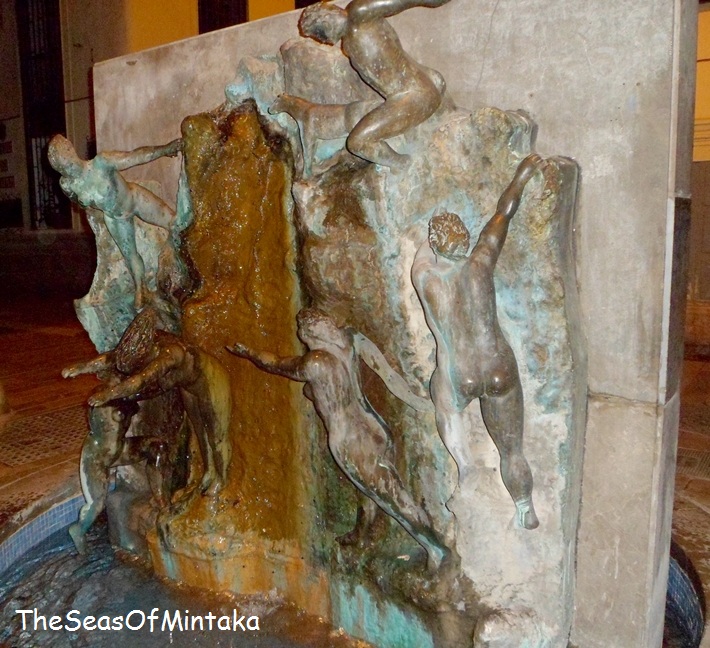
Wandering along calle Beatas, a pretty jazzy district known for its bars and discos, we discovered a couple of strange things I hadn’t seen before.
Fountain With Caños

This fountain looks pretty ugly, but I think it’s just the flash from the camera making it look kinda garish. This is the same angle without flash.

Fountain With Caños no flash

I was attracted to it immediately because we first saw it from the other side, the side with the faucets.

Cinco Caños

Springing fountains with taps or pipes, “caños”, are important in Spanish folklore and many songs are dedicated to them. In these traditional songs, the fountains usually have seven taps (siete caños), I dunno why but I guess seven is always a magical number and is always supposed to bring good luck.

However, the fountain on Beatas Street only had five taps.

We had actually gone off in search of the elusive “Hammam” or Arab baths. But we found them locked up and dark with a sarcastic note on the door cackling over the “nefarious” management of the former company that had been hired to take care of these facilities. Fortunately, the owner of the premises had apparently won some kind of court case (after four years!) over this nefarious management company, and now had recovered the full use of this historic site and was in the process of renovating and reforming it.

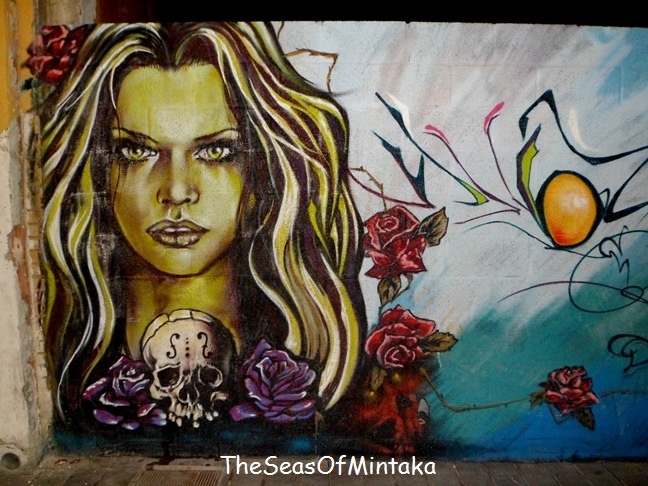
Street Art

Street art can be so beautiful sometimes.

Anyways, I was quite interested in getting away from our usual routine of Burger King or McDonald’s for dinner with a free toy thrown into the kiddie menu. The oldest is a little big for toys now, and the kiddie menu has about as much effect on his four stomachs as the proverbial egg in the giant’s stomach. The youngest still enjoys kiddie menus and free toys, but I was thinking that they were both ready to move on to more mature fare, all the same.

So I spied around for something “castizo”, something home-grown, something typically Spanish. Now, that’s pretty hard in downtown Malaga, where the streets are always crowded with foreign tourists.

But in the end we chose a nice little venue on calle Granada which seemed to have a few people, and they mostly looked Spanish. The menu was a reasonable price too. The kids clamoured for a kiddie menu, of course, and we had a debate as I preferred that they would try out something “adult” — as in, not French fries.

As a single mamma I have a tendency to endure less than satisfactory experiences in restaurants. The waiters usually give me a funny look when I walk in with two kids and no man beside me. They usually hover about me, probably most worried that I wouldn’t have the funds to pay for the meal, or that, even worse, I would take off without paying. As soon as I get up, they’re dashing over to me asking me if I would like something else or whether I’m ready to leave. And when I pay, they always count out the money most carefully while blocking the exit — just making sure it’s all there before I disappear, I guess.

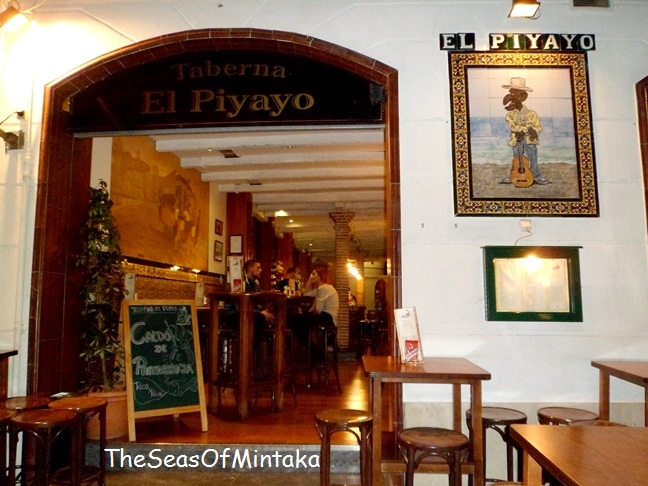
Tapas at El Piyayo

At “El Piyayo”, the waiter also had a slight confusion as well because he thought I was “waiting for my husband”, and therefore he didn’t serve me immediately. After a while, he started to become aware of the fact that there probably was no “husband”, and asked me whether I was waiting for my husband.

However, once I had made it clear to him that there was no husband, there hadn’t been one for some time but I devoutly hoped that one day in the future there would once again be a “husband”, the waiter turned into the sweetest, most educated person and started attending to us as if we were the only people in the restaurant. All our food arrived promptly, and he even threw in our drinks for free!

Taberna El Piyayo

So as you can see, we had a thoroughly great time and the meal was excellent! The atmosphere was warm, cosy and welcoming. There were photos of people singing and dancing flamenco around the walls, and the few patrons about spoke in low voices and all were clearly Spanish. No “guiris” here, apparently!

We had made a superlative choice! Which is why I am mentioning this little taberna here in this blog — but I hope tourists don’t start to descend upon it like flies now that the news is out! This is just a little secret for the few people who read this blog and happen to live in or near Malaga.

If you enjoyed this post (I really hope you do!), maybe you will also like:

On Christmas Day in the Morning

Malaga in Black and White

…And It’s a Rainy Night in Malaga

What We Do On Week-ends

CBBH Photo Challenge: Reflection

I don’t often get around to rummaging through old photos and picking out specific themes. But I felt like taking up the challenge from Marianne of East of Malaga today and putting up some photos with the theme of the month.

I’ve seen some neat galleries on other blogs, but I don’t know how to set up a gallery here so I guess I’ll just bumble along with the old traditional way: plunking down photos one by one!

Ciutadella Barcelona

This was from our trip to Barcelona. Seems such a long time ago!

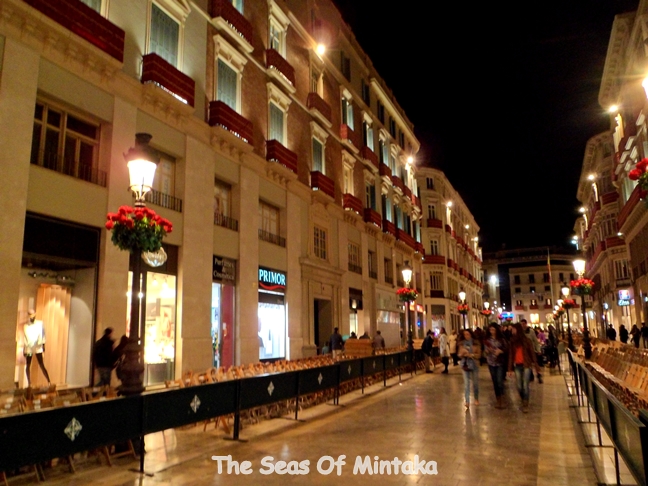
Calle Larios Malaga

Larios Street (calle Larios), the major pedestrian thoroughfare of downtown Malaga, is so beautifully lit up at night.

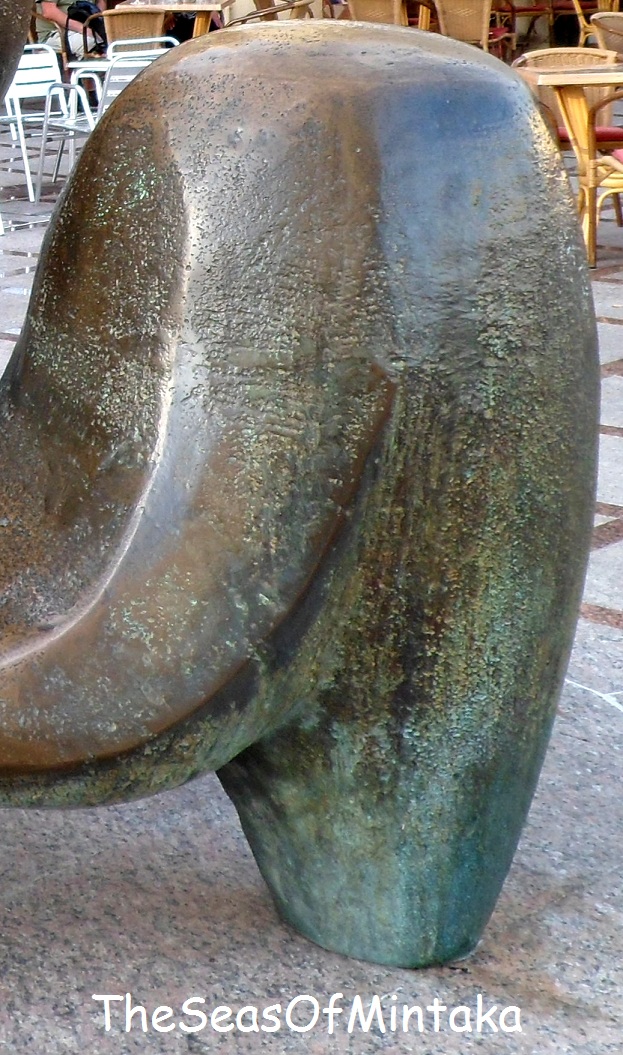
Chunky Statue

Thought this was a most unusual perspective on reflections, this statue, in Torremolinos, is polished so smooth you can even make out the details on the building it’s reflecting.

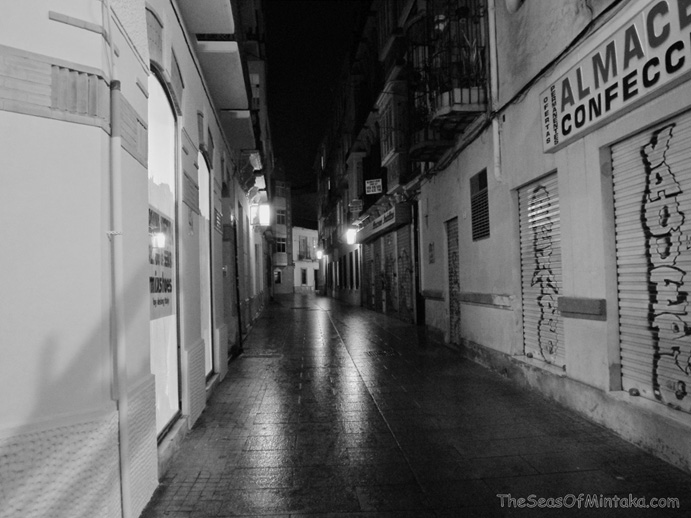
Malaga Street

These nocturnal alleyways are lovely in black and white too, and more mysterious at that.

Nebulous Reflections

I’m not going to tell you what that one is! I’ll leave it up to your imaginations!

Rio Chillar River

This was a scenic gorge you can wade through on the Chillar River near Nerja.

River Malaga

Shadows in the Water

This could be any city, any riverbank, any reflection.

Well, I would like to link to Toby at Travels With Toby, who reminded me about the CBBH Photo Challenge. She’s travelled a lot, and with any luck, one day she’ll be my neighbour here in Spain!

Then I’d like to recommend another blog even though it isn’t really related to travelling, photography or Spain, A Sprinkle of Al Sharq. What Sprinkle and I both have in common is we’re both single mums! I know lots of single mums but even with that, I think we’re still a minority.

If you enjoyed this post (I really hope you do!), maybe you will also like:

Happy Giant Cockroach Hunting!

Andalucía Cuatro de la Tarde

How Much Do YOU Value Your Friends?

Hot Muggy September Nights